Poverty doesn’t usually end with a single breakthrough. More often, overcoming poverty means a meal every day, a ride to school that never gets missed, and a counsellor who stays through the hard years. None of these, on its own, changes a life. Strung together over a decade, they can.
Christel House calls this Full Circle Support: a network of catalysts (nutrition, education, healthcare, character and leadership development, caregiver engagement, and college and career preparation) that reinforce each other over time rather than operating in sequence. What that looks like in practice is easiest to see across a span of years. Christel House stays with a student from kindergarten through five years after graduation. Three students, at three different points in that span, show what the years in between are actually for.
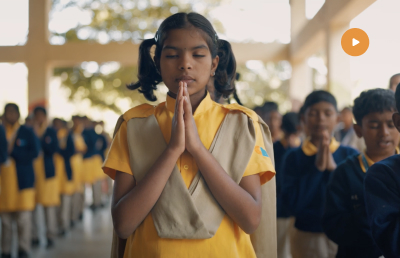
Ask Sinchana, a Grade 4 student at Christel House India, to describe herself, and she doesn’t hesitate:
“I am the strongest. I am a very healthy girl, and I eat vegetables and fruits every day. I am a clever student. I am a respectful girl. I will respect everyone.”
Her school day is built from small, repeated routines: she brushes her teeth, dries her hair, combs it, puts on her ID card, belt, and shoes, and takes the bus to school. In class, she’s reading about Pinocchio, delighted that his nose gives him away every time he lies. She loves art “because it teaches me to color, to write, and to draw.”
None of this looks like an intervention. That’s the point. At this stage, Full Circle Support isn’t yet about career coaching or college pathways. It’s nutrition, health, and a stable routine, doing quiet, foundational work. A child who eats well, isn’t missing school, and has the headspace to notice that she loves a particular book and a particular subject is laying the foundation (curiosity, confidence, a settled sense of self) that later stages of support will have something to build on. Sinchana doesn’t have a career plan, and she shouldn’t yet. What she has is time and the security to use it.
“Before I joined Christel House, my parents struggled to provide for us, let alone send us to good schools,” Angel says. She dropped out when her family could no longer afford the school fees—a loss she still describes as heartbreaking, made harder by watching her older brother come home every day and describe how much he loved his new school.
When she was admitted into fourth grade at Christel House, she remembers walking in as “a shy, timid girl who was not sure what the future had in store for her. ” What changed wasn’t any single year that followed. It was nine consecutive ones. “Every time I walked into the school, it felt like heaven on earth,” she says of the food, transport, and healthcare that removed the practical reasons for which a family like hers might have pulled her out again.
Because those basics were handled, she had room for something Full Circle Support treats as its own catalyst, not an afterthought: character and leadership development. A six-month placement at the Calver Leadership Camp in the United States put her alongside students from 40 countries, an experience she couldn’t have used if food, transport, and school fees had still been open questions that year. She calls it “a rich learning experience” that taught her “leadership skills, tolerance, and acceptance.” But the lesson she names as most important is simpler: “Not to give up whatsoever, and to be an optimist. I have learned to look at problems as challenges and to face them with courage.”
Angel graduated in 2013, went on to undergraduate and postgraduate degrees in psychology, and returned to Christel House, this time as the school counsellor. Today, she stands on the other side of the relationship that once carried her through. Nine years weren’t ‘reserve’before the “real” outcome. They were the mechanism the outcome depended on.
Alejandra was too young, on her first day at Christel House Mexico, to understand what she was looking at. She remembers being sent to breakfast, given school supplies, and sensing, without the words for it yet, that something in her life was about to change. “Before Christel House, my life was small,” she says now. “I didn’t realize there were financial struggles at home.” It’s only as an adult, looking back, that she can name what she couldn’t see as a child.
That gap, between what a child experiences and what the support around her is actually solving, is where Full Circle Support does some of its least visible work. It wasn’t only Alejandra’s education that changed. Her parents, she says, gained “stability… knowing I was going to become a professional, that I would no longer depend on them.” Caregiver support runs in both directions over time, and Alejandra’s story is testament to it: today, she’s the one supporting her parents financially, not the other way around.
She’s a psychologist now, working in organisational development at a financial institution. What she still repeats, “El origen no define el destino” (your origin does not define your destiny), isn’t a slogan she picked up. It’s a description of what happened to her. Her own words for it, addressed directly to Christel House, are the clearest summary anyone could write: “Thank you for believing in the hidden talent behind a need. Thank you for planting hope in thousands of families like mine. Thank you for changing lives with love and vision.”
Sinchana, Angel, and Alejandra aren’t three separate success stories that happen to share a school. They exemplify three positions on the same timeline, which is why none of them makes full sense without the others. Sinchana shows what the early catalysts (nutrition, health, stability) are building toward, even though the process is invisible from where she stands. Angel shows what happens when those catalysts compound uninterrupted for nearly a decade: a leadership camp becomes usable, a degree becomes reachable, and a former student becomes qualified to do for others what was once done for her. Alejandra shows where the line ends up: not just a credential, but a reversal. A child once supported by her family’s sacrifice now supports that family back.
All of these stories are those of how we quietly, resiliently fight against poverty alongside our students.

Full Circle Support is often described by what it includes. Sinchana, Angel, and Alejandra make the case for why duration is the part of the story that’s easy to leave out of that description and how it is that very part that actually does much of the work.
CATALINA PIMIENTA GOMEZ NAMED FOUNDING CEO OF CHRISTEL HOUSE COLOMBIA
CHRISTEL HOUSE INTERNATIONAL LAUNCHES NEW DOCUMENTARY, “FROM CLASSROOMS TO LIFE”
FUNDACION SANTO DOMINGO AND CHRISTEL HOUSE INTERNATIONAL ANNOUNCE HISTORIC ALLIANCE TO TRANSFORM EDUCATION IN COLOMBIA
CHRISTEL HOUSE EXPANDS TO TWO COUNTRIES, SELECTED AS CLINTON GLOBAL INITIATIVE COMMITMENT MAKER
TANESHIA STONEY DRYDEN NAMED CEO OF CHRISTEL HOUSE JAMAICA